Methodology
How this board was built
A ranking is only worth the assumptions it publishes. These are all four of them — the identity master, the pressure definition, the shrinkage, and the ordering rule — followed by the places the model can be wrong.
1 · Identity before analysis
The feed's own capped flag is wrong in both directions: it calls
Ajinkya Rahane and Nitish Rana uncapped, and it has no idea Yash Thakur debuted for India in
July 2026. Cap status is therefore joined from a hand-checked master of 86 players, and the
master wins wherever the two disagree. The feed's age field is worse: it
defaults a missing birthdate to 24.0, which is plausible, quiet and fictional. Every age
here is computed from a verified DOB against a fixed reference date of 10 November 2026.
Where a DOB is unverified, the youth term is forced to zero rather than guessed. A model that cannot see a birthdate must not award a youth premium.
2 · Defining pressure without a scorecard
Match state is rebuilt from the delivery stream — cumulative team runs, the first-innings target, and legal balls elapsed. A delivery is a pressure ball if it falls in overs 16–20, or in any chase requiring 10+ runs per over with a ball left.
Structural
Overs 16–20 of any innings. The batting side must maximise variance and the bowling side must defend, whatever the scoreline says.
Situational
Any over where a chasing side needs 10+ per over with a ball left. This catches the middle-overs squeeze that a death-overs filter misses entirely.
3 · Shrinkage, then scoring
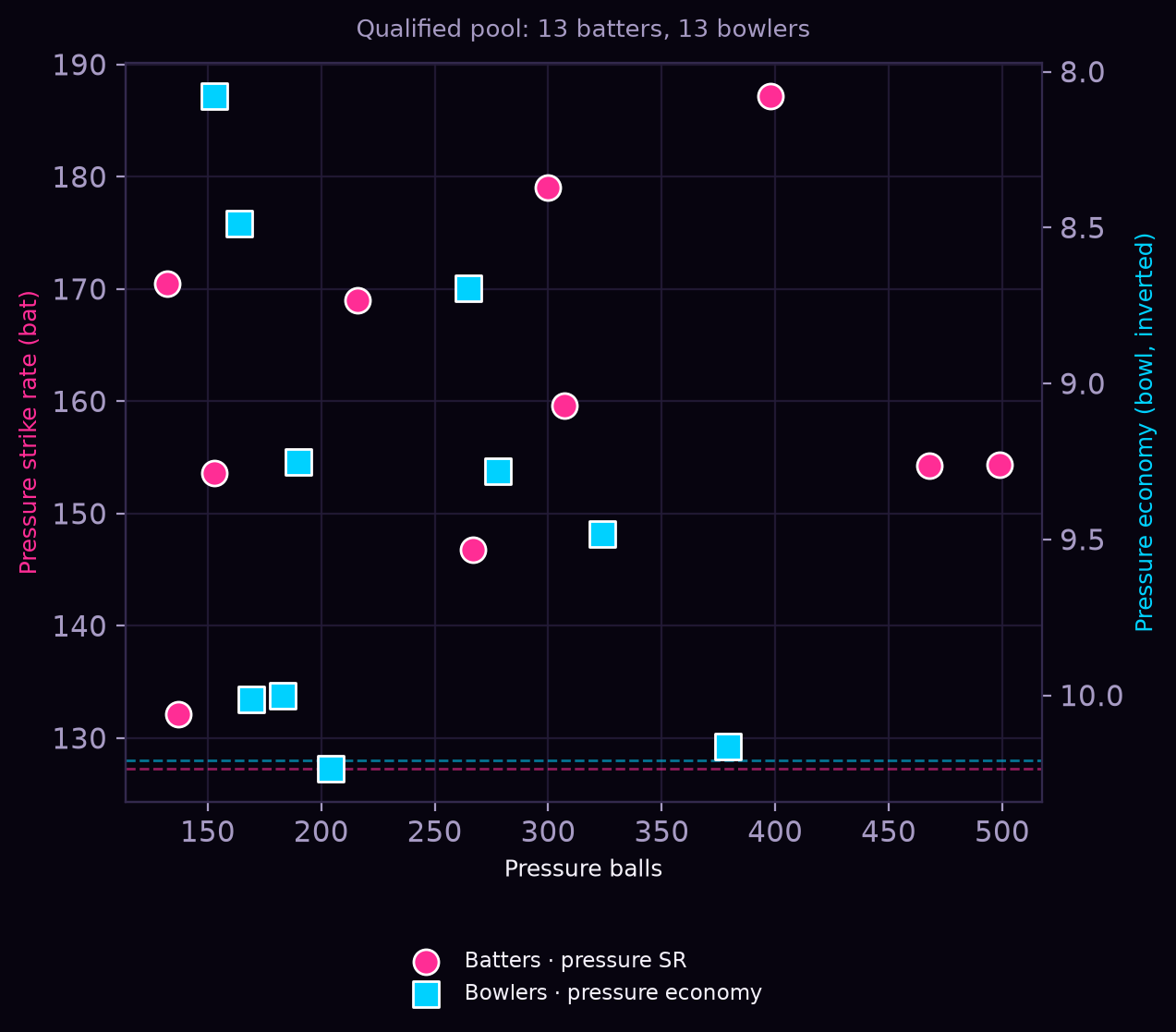
Raw pressure numbers lie: the top of that leaderboard is a teenager with 90
balls. Every rate is pulled toward the pool mean by n / (n + 220) before it is
scored, so volume has to be earned. The components are then z-scored and weighted —
batters on level 0.40 / resilience 0.32 / survival 0.28 plus a 0.15 youth term; bowlers on
level 0.38 / resilience 0.24 / penetration 0.24 / control 0.14 plus the same youth term.
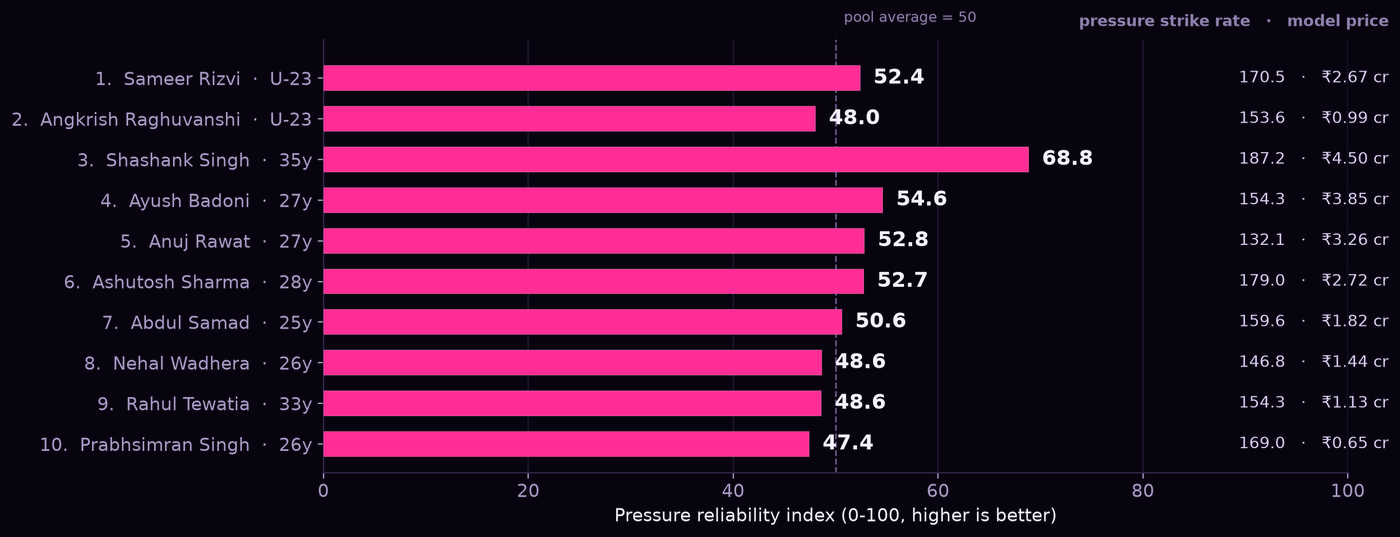
PRI = clip(50 + 12.5 × z, 1, 100), with 50 pinned to the
qualified-pool average. A PRI of 70 is not a 70% chance of anything; it means the player sits
roughly 1.6 standard deviations above the pool on a composite of pressure performance.
4 · The U-23 rule, and what it costs
Verified U-23 players are sorted ahead of seniors, then each tier is ordered by
reliability. This is a selection rule, not a scoring tweak — which is why the pure
reliability order is published alongside it as rank_pure, so a reader who
disagrees with the youth rule can re-sort the board in one line.
Where this can be wrong
The U-23 pool is thin, not deep
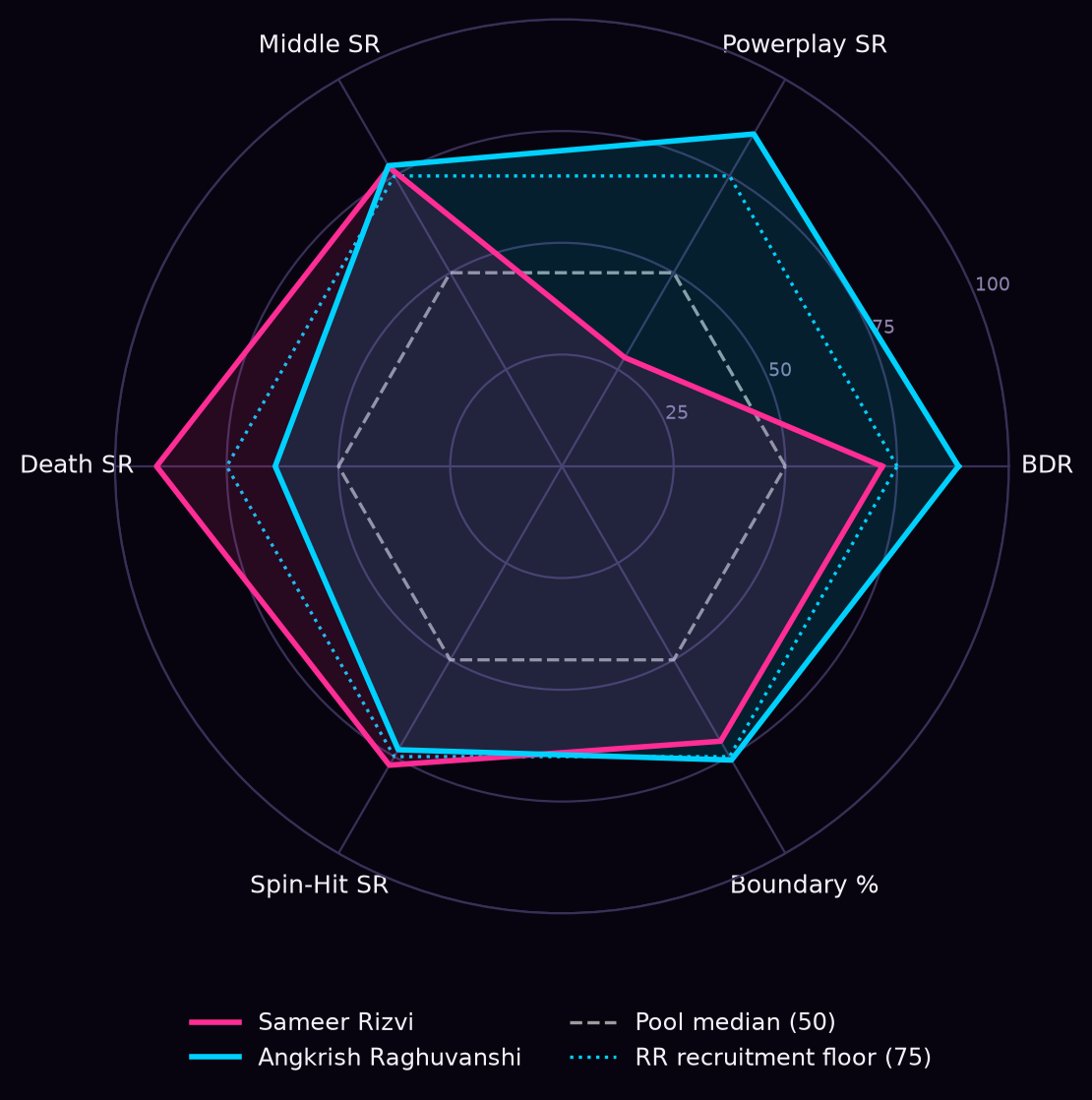
Only one U-23 uncapped bowler in the feed has a rankable pressure sample. Sakib Hussain at 153 pressure balls is a bet on a ceiling, not a proven floor.
Verified identity is manual
Cap status and DOB come from a curated master, not the feed. A player absent from it is excluded rather than guessed — an exclusion is reversible, a fabricated birthdate is not.
No opposition weighting
Facing a frontline international seamer in a pressure over and facing a fourth-change bowler both count as one pressure ball. A quality-of-opposition adjustment is the single biggest improvement available.
No venue or conditions adjustment
A player whose pressure numbers were built on flat decks will look better here than he will in Jaipur.
Full method and justification
The 13-page report carries the complete derivation, per-player justifications and the sensitivity table.